
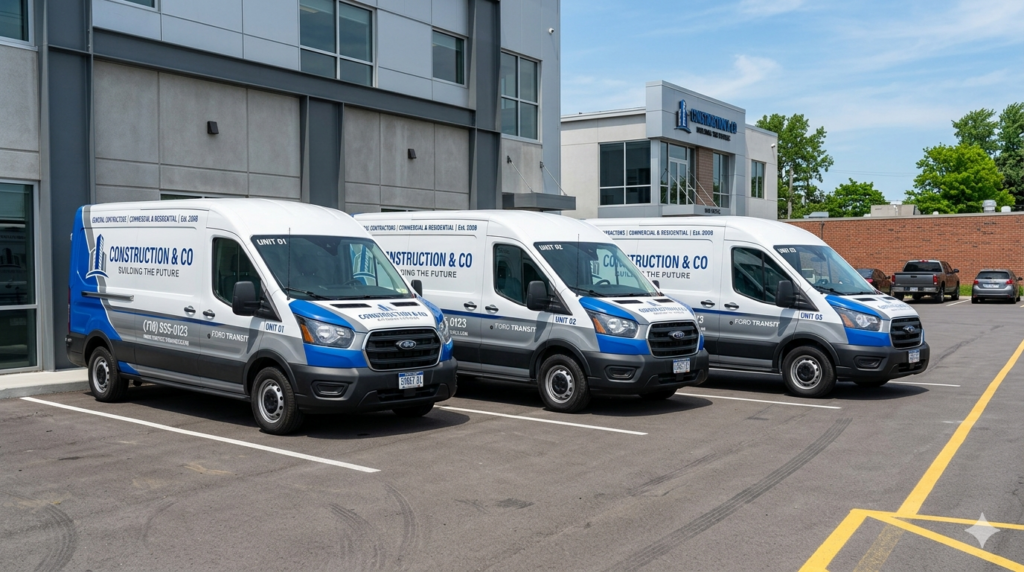
Personal vs. Commercial Auto — Why the Distinction Matters on a Job Site
Most contractors don’t think twice about driving their personal truck to a job site, but your personal auto policy almost certainly excludes coverage when the vehicle is being used for business purposes. This isn’t a grey area. If you’re hauling tools, driving between client locations, or transporting employees and an accident happens, your personal insurer can and likely will deny the claim.
The fix is straightforward: commercial auto coverage is specifically designed for vehicles used in the course of business. It covers the same scenarios your personal policy won’t, and it’s built around the realities of how contractors actually operate day to day. The cost is often more reasonable than contractors expect, especially when placed through the right admitted market.
How Driving History Actually Affects Your Rate — And the Flexibility Some Carriers Now Offer
One of the biggest misconceptions contractors have about commercial auto is that a few blemishes on a driver’s record automatically mean high premiums or outright rejection. That used to be closer to the truth. It’s less true today.
Carriers have gotten smarter about how they price risk. Rather than blanket exclusions, they now evaluate driving history on a more nuanced basis. In many cases, one to two MVR violations per driver over the prior three years, things like a speeding ticket or a minor moving violation are still acceptable. One prior at-fault accident per driver may also be workable, as long as the total number of accidents across your fleet stays below a certain threshold relative to your number of vehicles.
What this means practically: don’t assume you can’t get competitive commercial auto just because your drivers aren’t perfect. Let a broker shop it. You may be surprised by what’s available.
Fleet Size and How It Affects the Submission and Quoting Process
Whether you have one truck or fifteen, the process of getting commercial auto coverage looks a little different based on fleet size — and knowing what to expect can save you time.
For smaller fleets, the quoting process has gotten significantly faster. Many carriers now use third-party integrations to pre-fill vehicle and driver information, which means less paperwork on your end and a quicker path to a quote. For fleets of ten or more vehicles, loss runs — a record of your prior claims history, are typically required, though exceptions exist.
One thing worth understanding: the total number of accidents across your fleet matters. Carriers generally look at whether your total accident count is less than 50% of your number of power units. So a fleet of ten vehicles with four accidents is going to look different than a fleet of ten vehicles with one. This is one of the reasons working with a broker who knows how to position your account not just submit it, makes a real difference.
Why Your Garaging Location Matters More Than You Think
This one surprises a lot of contractors: where your vehicles are garaged at night plays a meaningful role in how your commercial auto policy is underwritten and priced.
Carriers evaluate risk based on the garaging location, not just where the work happens. A vehicle garaged in a rural area is typically rated differently than the same vehicle kept in a dense urban market because the frequency and severity of accidents, theft, and other incidents varies by geography. If your drivers live and park their vehicles in different areas, each vehicle’s garaging address should be accurately documented in your policy.
Beyond pricing, getting this detail right protects you at claim time. If a vehicle is listed with an incorrect garaging location and a loss occurs, it can complicate or jeopardize the claim. It’s a small administrative detail that has real consequences, and it’s one of the things WiseCore reviews carefully when putting together a commercial auto submission.
Vehicle Wraps or Specialty Painting — A Costly Oversight Most Contractors Don’t Catch Until It’s Too Late
If you’ve invested in wrapping your work trucks or vans with your company’s branding, you already know it’s not cheap. A professional full wrap can run anywhere from $2,500 to $5,000 or more per vehicle and that’s before you factor in design costs. For a contractor with a fleet of five or ten wrapped vehicles, you’re looking at a significant marketing investment riding around on four wheels every day.
Here’s the problem: most standard commercial auto policies treat a vehicle wrap the same way they treat the factory paint underneath it, as part of the vehicle’s base value, not as a separate, insurable asset. When a claim is filed after an accident, vandalism, or theft, many contractors are blindsided to learn that the cost to replace the wrap isn’t covered or is only partially reimbursed at a depreciated value that doesn’t come close to what a new wrap actually costs.
Why this happens: Commercial auto policies are primarily designed to cover the vehicle itself, its structure, mechanical components, and in the case of comprehensive coverage, losses from non-collision events. A wrap is considered a “betterment” or aftermarket addition by many carriers, which means it may be excluded entirely or subject to depreciation schedules that bear little resemblance to real-world replacement costs.
What to ask your broker:
- Is my vehicle wrap covered under my current commercial auto policy?
- If so, is it covered at actual cash value or replacement cost?
- Does coverage apply to partial wrap damage, or only total loss scenarios?
- Should the wrap be scheduled separately as a business property item?
In some cases, the cleanest solution is to schedule the wrap value as an endorsement on the commercial auto policy, the right approach depends on your carrier and how your overall program is structured. This is exactly the kind of detail an independent broker should be reviewing with you.
The bottom line: If your trucks are wrapped, don’t assume you’re covered for the full replacement cost. Verify it. A $3,500 wrap that isn’t covered is a $3,500 out-of-pocket expense multiplied by however many vehicles you’re running. For a contractor who relies on branded vehicles as part of their professional image and marketing, that’s a gap worth closing before a loss happens, not after.